
Colarusso's unusable objects


There's a Japanese art called chindogu, which has become something of a cult since inventor Kenji Kawakami coined the term about two decades ago. The word literally means "unusual tool," and though the gadgets that fall under this category can be a little embarrassing to utilize, they can't be considered as "useless" in an absolute sense. 

   But Giuseppe Colarusso's creations are different, and each object becomes a bit of a puzzle to solve. They're either highly unusable, technically impossible, or utterly annoying in their uselessness. A lot of these objects were fabricated by the Italian artist himself, however some were manipulated using Photoshop.
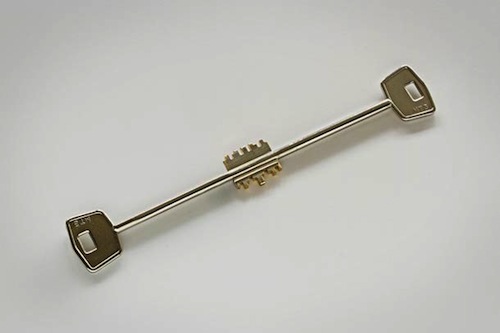


   Colarusso's Improbability series tests our patience, but at some point it also manages to put a smile on our faces. You can find more of this imaginative series on his website.

[h/t: Ignant]

Comments

Popular posts from this blog

Eagle Blue

Set to Julia Holter's This is a True Heart, Eagle Blue follows the story of a mother eagle looking to feed her young, but is lured into the town with the temptation of an easy meal.

Preserved tattoos of the dead

The idea of preserving tattoos after death came into existence long before NAPSA . London's Wellcome Collection has over 300 specimens of preserved human flesh bearing tattoos , collected in the late 19th century. There are many more examples of smaller collections in Paris, Poland, Portugal, Berlin, and Austria. But what fascinates me the most is this lesser-known museum at Tokyo University, the Medical Pathology Museum, which houses pieces of skin collected since 1926 by Dr. Masaichi Fukushi. "Fukushi would perform autopsies on donated cadavers and dissect off just the skin. He created a method of treatment to preserve the skin and kept them stretched in a glass frame, essentially like a leather. Later the ownership of the tattooed skin collection was passed on to Fukushi's son Katsunari. Katsunari added a further 20 tattooed skins himself and it's believed that the Medical Pathology Museum has 105 in its collection, many with full body suits." ...

Powered by body heat, this tiny flashlight doesn't need batteries

For the past ten years or so, I've made it a habit to carry a tiny penlight in my pocket whenever I travel. I wouldn't consider myself a hardcore flashlight enthusiast, but when I was younger I used to collect flashlights of different shapes, sizes and output colors. I still have them, lying somewhere in the house, ready for action in case of a zombie apocalypse. If you're looking for a small flashlight with enough light output to find objects in the dark but would rather not keep supplying it with batteries, you might be interested in Lumen. It doesn't need any external energy source except your body heat. Ross Zhuravskiy is using Kickstarter to raise funding for his creation, and with 26 days until his initiative closes, he officially surpassed his initial $5,000 goal thanks to 477 backers. So how does it work? "Lumen has relatively simple work principle - you touch TEG (Thermoelectric Generator) - small ceramic bar that can produce electric current when ...