
Unconventional Portraits by Red


Hong Yi is one of my favorite artists to have discovered this year. The talented Malaysian hottie, who often goes by the nickname Red, likes to paint... but not with a paintbrush. Instead, she uses everyday objects like socks, sunflower seeds, melted candles, coffee cups, and chopsticks to create stunning pictures.

Who wouldn't be amazed by the portrait of Facebook founder Mark Zuckerberg that Red created out of 36 books by carefully slicing off the sides of the pages, or the rather unusual image of famed Chinese filmmaker Zhang Yimou made of 750 pair of socks?

Red could do almost anything with her hands but the most remarkable work she did was with food. Among her most impressive pieces was a coffee cup stain portrait of Italian singer Lucio Dalla. "Patience has developed overtime," she said. "I studied architecture for six years, and it trained me to work very hard until late at night. There was a certain discipline in my life during my university years. If I didn't go through that, I think I wouldn't be as patient as I am now."

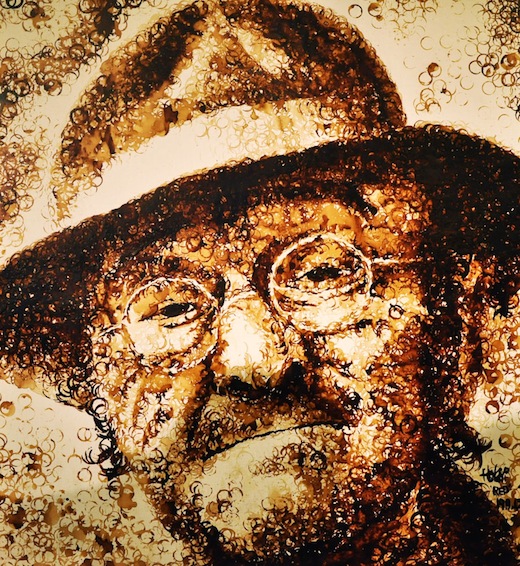


Follow Red on Instagram and see more of her work here.

Comments

Popular posts from this blog

Italy's True Movie Poster King

What you see here is the hand-crafted magic of Renato Casaro, the late Italian designer who practically defined an era of cinematic cool. His work wasn't just advertising; it was art. Casaro's journey into becoming one of the most recognizable poster artists wasn't by chance; it was a pure obsession. As a kid, he was fascinated by billboards, trying to mimic the styles of Norman Rockwell and Angelo Cesselon. Think of a teen so determined that he was drawing right onto the walls of a local cinema just to snag a few free tickets. Casaro created posters for a lot of Spaghetti Westerns. His big break came with A Fistful of Dollars in 1964. The movie starred Clint Eastwood and was directed by Sergio Leone. The poster didn’t just promote the film; it helped make it a global hit. Naturally, Leone came calling again, commissioning posters for My Name Is Nobody (1973) and the epic crime saga, Once Upon a Time in America (1984). A Casaro poster is easy to spot because of his uniqu...

She Knows You’re Looking

To be honest, the first thing I noticed in these portraits wasn’t the texture, the lighting, or the color palette. It was her. Who is she? Is she real, or is she imaginary? Does she have an Instagram? I was hooked right away. I mean, I’m a guy. So yeah, I felt something at once. If you caught yourself staring a little longer too, don’t worry. You’re not alone. In most of these Roberto Martin Sing pieces, she looks straight at you. Her gaze isn't aggressive, but it isn't shy either. It's more like she's saying, “Hi. I know you’re looking. It’s fine.” In one painting, the young woman is rising from the water with full nymph energy. Men have been falling for this stuff since ancient Greece. She’s the goddess in the forest or the woman in the lake. There’s soft light, glowing skin, and zero real-world problems. She looks very feminine without being flashy. Inviting without trying too hard. And you can’t help but wonder what she’s thinking. The work moves between contempora...

The Unseen Emotional Landscape

I'm currently obsessed with Pon Arsher . Her paintings are like a stylish cage fight between realism and abstraction, and every human figure seems to be nursing a perfectly haunting and beautiful existential hangover. On my computer, it's cool. But I want to see the real deal. The internet is probably the greatest gallery humanity has ever created. But sometimes, a piece of art leaps off the screen and refuses to be contained by your monitor. Anyway, when she was young, the self-taught Moldovan artist found drawing in silence more fulfilling than socializing. But she wasn't avoiding life; she was capturing it. Drawing wasn't an escape from friends, but an intense conversation with the most essential, silent part of her soul. Her art looks like an emotional x-ray, and it lulls me into a dream state. It's also a reminder, for herself and viewers, that our feelings—even the bad ones—are valid. Ms. Arsher proves that art only needs an authentic voice and the courage to ...