
This Filipina artist draws with thread


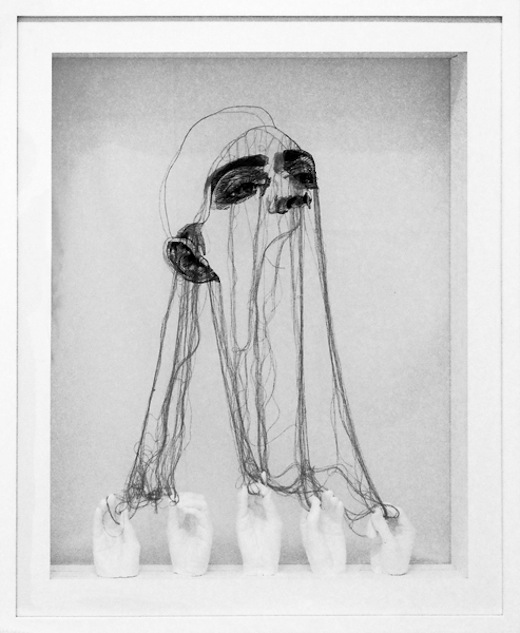
I love it when I procrastinate online and discover someone's work that really catches my attention. Filipina artist Eugenia Alcaide captures her subjects by sewing their impressions on silkscreens. Though created with black cotton thread, the lines look like intricate sketches of graphite with 3D feel. They're captivating, and I wish there was a video to go with these to see how she plots each piece from start to finish. 

Ginny began using thread in 2006 while doing her thesis for her degree in Fine Arts, major in Painting, at the University of the Philippines. One of Artinformal's most revered artists, her first exhibit in the gallery was in 2012, and since then she has gone on to display her work in various local and international art fairs. Her unique ability to create three-dimensional portraits by stretching and draping threads to form sculptural drawings has earned her much acclaim.



You can check out more of Ginny's work here.

Comments

Popular posts from this blog

Italy's True Movie Poster King

What you see here is the hand-crafted magic of Renato Casaro, the late Italian designer who practically defined an era of cinematic cool. His work wasn't just advertising; it was art. Casaro's journey into becoming one of the most recognizable poster artists wasn't by chance; it was a pure obsession. As a kid, he was fascinated by billboards, trying to mimic the styles of Norman Rockwell and Angelo Cesselon. Think of a teen so determined that he was drawing right onto the walls of a local cinema just to snag a few free tickets. Casaro created posters for a lot of Spaghetti Westerns. His big break came with A Fistful of Dollars in 1964. The movie starred Clint Eastwood and was directed by Sergio Leone. The poster didn’t just promote the film; it helped make it a global hit. Naturally, Leone came calling again, commissioning posters for My Name Is Nobody (1973) and the epic crime saga, Once Upon a Time in America (1984). A Casaro poster is easy to spot because of his uniqu...

Preserved tattoos of the dead

The idea of preserving tattoos after death came into existence long before NAPSA . London's Wellcome Collection has over 300 specimens of preserved human flesh bearing tattoos , collected in the late 19th century. There are many more examples of smaller collections in Paris, Poland, Portugal, Berlin, and Austria. But what fascinates me the most is this lesser-known museum at Tokyo University, the Medical Pathology Museum, which houses pieces of skin collected since 1926 by Dr. Masaichi Fukushi. "Fukushi would perform autopsies on donated cadavers and dissect off just the skin. He created a method of treatment to preserve the skin and kept them stretched in a glass frame, essentially like a leather. Later the ownership of the tattooed skin collection was passed on to Fukushi's son Katsunari. Katsunari added a further 20 tattooed skins himself and it's believed that the Medical Pathology Museum has 105 in its collection, many with full body suits." ...

Roamcouch in Fukushima

Ryo Ogawa, better known as Roamcouch, recently finished this beautiful art piece in Fukushima. The 43-year-old Japanese street artist spent four days working on the mural and was joined by local kids in spray painting the stars on the side of the windmill. Influenced by manga, Roamcouch is known for his impressive works that can require up to fifty different layers of stencils. Incredibly, each stencil is both hand-drawn and hand-cut by the Gifu native himself. Roamcouch spray-paints on top of each stencil until he gets his desired results. His work has been featured at solo and group exhibitions in Japan, Norway, London, Malaysia, Germany, France, and in the US. In 2014, he opened his first solo show, titled A Beautiful Life , in New York and achieved an amazing feat of selling out the entire collection. Roamcouch has a Facebook page that updates quite often and a website where you can find all his work.